
You bought a beautiful set of bangles. Three wears later, the shine is gone and there’s a greenish mark on your wrist. Sound familiar? That moment, that disappointment is exactly what anti-tarnish technology is designed to prevent. But the term gets thrown around so freely by sellers today that most shoppers don’t actually know what it means, how it works, or whether a ₹299 bangle claiming “anti-tarnish” delivers the same thing as a ₹999 one. This guide gives you the real answer. how to care for artificial jewellery →
Key Takeaways
- Anti-tarnish means the jewellery resists oxidation, the chemical reaction that turns metal dark, dull, or green on your skin.
- India’s artificial jewellery market is valued at approximately ₹45,000 crore (USD 4.98 billion) as of 2025, growing at 10–11% CAGR (MarkNtel Advisors, 2026).
- The key variable is the base metal, not the coating alone, stainless steel resists tarnish naturally; brass and copper do not.
- PVD coating bonds at a molecular level and is significantly more durable than standard electroplating for daily wear.
- No plated jewellery is tarnish-proof forever, but with the right base and coating, good pieces last 2+ years with basic care.
What Does “Anti-Tarnish” Actually Mean?
Anti-tarnish jewellery is jewellery made or treated with materials that resist the natural oxidation process, retaining its colour and surface finish significantly longer than conventional fashion pieces (Banglecart, Best Anti-Tarnish Jewellery Under ₹2,000, 2026). In plain terms: it stays shiny longer. It won’t go dark after two wears. And it won’t leave a green ring on your wrist: at least not for a long while.
The word “tarnish” refers to a specific chemical reaction. When metal contacts oxygen, moisture, sweat, or sulfur in the air, it oxidises. Silver darkens. Brass turns green. Copper stains your skin with that tell-tale ring. All of this is chemistry, not bad luck. Anti-tarnish is the engineering response to that chemistry.
Anti-tarnish jewellery resists oxidation: the chemical reaction where base metals like brass and copper react with moisture, sweat, and oxygen. The result without treatment: darkening metal, a green mark on the skin, and a piece that looks worn after just a few uses. The solution is a combination of base metal choice and protective coating technology.
Our finding: Most sellers use “anti-tarnish” to describe the coating alone. But the base metal underneath matters just as much. A quality anti-tarnish coating over a brass base still allows tarnishing once the coating thins. A stainless steel base with basic plating resists tarnish better than brass with three layers of coating. Knowing this distinction is how you shop smart.
Why Does Jewellery Tarnish in India Specifically?
India’s climate makes tarnishing happen faster than in most parts of the world. Humidity levels in cities like Mumbai, Chennai, Kolkata, and Lucknow regularly exceed 70–80% during the monsoon a nd sweat production in Indian summers is consistently high. Both humidity and sweat are key triggers for the oxidation reaction that causes tarnish.
Add to that: perfume applied near jewellery, heavy use of skincare products, and the fact that Indian women often wear bangles and earrings for extended hours during festivals, weddings, and daily routines. The result is that a piece of brass-base fashion jewellery that might last six months in a European climate can tarnish within weeks in Delhi or Chennai.
In India’s heat and humidity, most conventional fashion jewellery simply gives up quickly. Brass and copper bases react with sweat and monsoon moisture far faster than in low-humidity climates, which is precisely why anti-tarnish technology matters more here than almost anywhere else. Pieces that last six months in Europe can darken within weeks in Indian conditions. [UNIQUE INSIGHT: BangleCart Team, 2026]
This is also why the Indian artificial jewellery market has seen explosive growth in anti-tarnish products. According to Technavio’s India Costume Jewelry Market report (March 2026), the market is projected to grow by USD 1.30 billion at a CAGR of 11.6% from 2025 to 2030, with durability and quality improvement listed as key drivers of this expansion.
What Is Anti-Tarnish Made Of? The Base Metal Matters Most
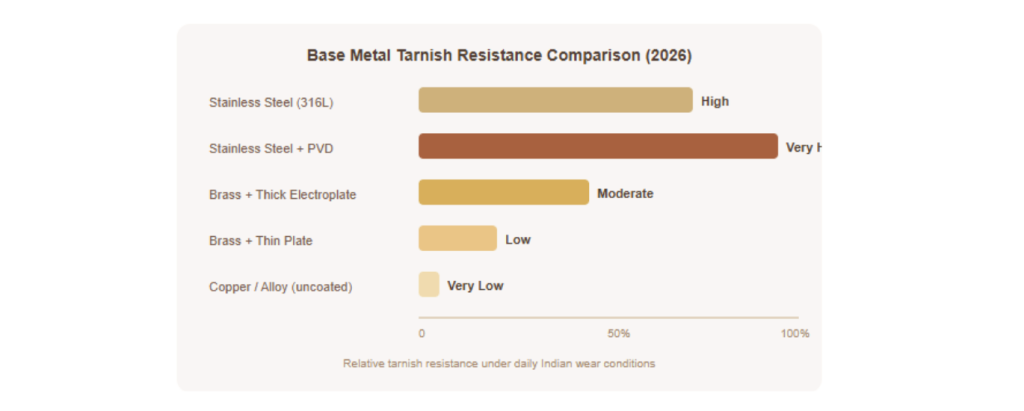
In 2026, the two most common base metals in Indian anti-tarnish jewellery are brass and stainless steel, and they behave very differently. Surgical-grade 316L stainless steel paired with PVD (Physical Vapour Deposition) coating creates a bond that holds under daily wear, sweat, monsoon humidity, and even gym sessions (Ektaraa, 2026). Brass with standard electroplating is more common and more affordable, but its tarnish resistance is meaningfully lower.
Here’s why the difference matters:
- Brass / copper base: These metals react quickly with moisture and sweat. The gold coating on top is often very thin, sometimes just microns, and once it wears away, the base metal is exposed and tarnishing begins rapidly. This is also what causes the green mark on your finger (Aferando, Best Anti-Tarnish Jewellery India, 2026).
- Stainless steel base: Stainless steel contains chromium, which naturally resists oxidation. Even if the gold coating fades over time, the base metal underneath doesn’t react the same way, so you get no green marks and far less darkening.
- Oxidised / lacquered silver-finish pieces: Traditional Indian jewellery often uses an intentional oxidised finish (a controlled tarnish), which should not be confused with accidental tarnishing. These pieces are meant to look antique and dark.
What Is PVD Coating and Why Does It Matter for Anti-Tarnish?
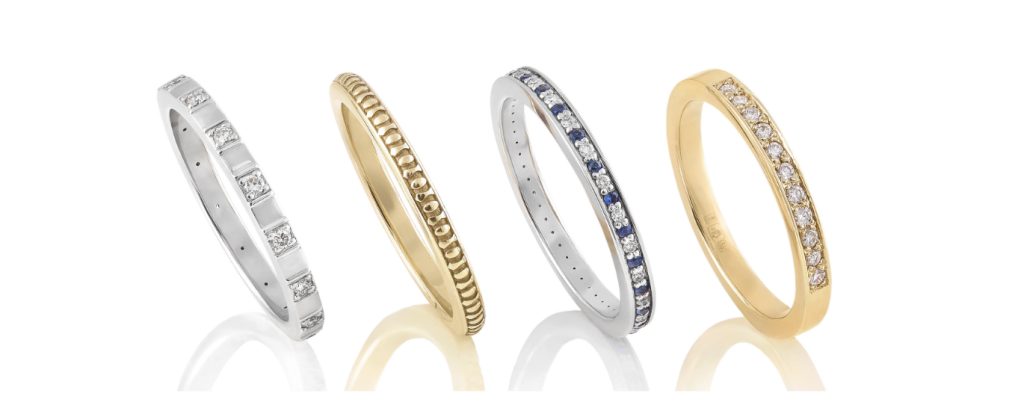
PVD: Physical Vapour Deposition is not marketing language. It’s a manufacturing process where the colour layer bonds to the metal at a molecular level inside a vacuum chamber, rather than sitting on top of it through an electrical bath. The result is a coating that is significantly harder and more durable than electroplating (Aesthla, Best Materials for Anti-Tarnish Jewellery India, March 2026). High-quality brands use PVD coating on stainless steel for pieces that can last two or more years under daily wear.
Standard electroplating, by contrast, deposits metal ions onto the surface using an electrical current. The bond is weaker. The layer wears off faster. especially on edges, clasps, and inner-wrist contact points. For a bangle that touches your skin all day, the difference is significant.
PVD coating bonds the finish to stainless steel at a molecular level inside a vacuum, creating a surface that resists wear, sweat, and friction far better than electroplating. For Indian women who wear bangles during work, festivals, and gym sessions, this distinction determines how long a piece stays beautiful. PVD on 316L stainless steel is the most durable anti-tarnish option available in fashion jewellery today. [BangleCart Team, 2026]
One important nuance: PVD works best on stainless steel. On brass and silver, electroplating is actually the more reliable choice. PVD’s bond on chemically reactive metals like brass is less stable over time (Nendine, PVD Coating vs Electroplating, March 2026). So the best approach depends on the base material, not just the coating technique.
How Do You Know If Jewellery Is Truly Anti-Tarnish?
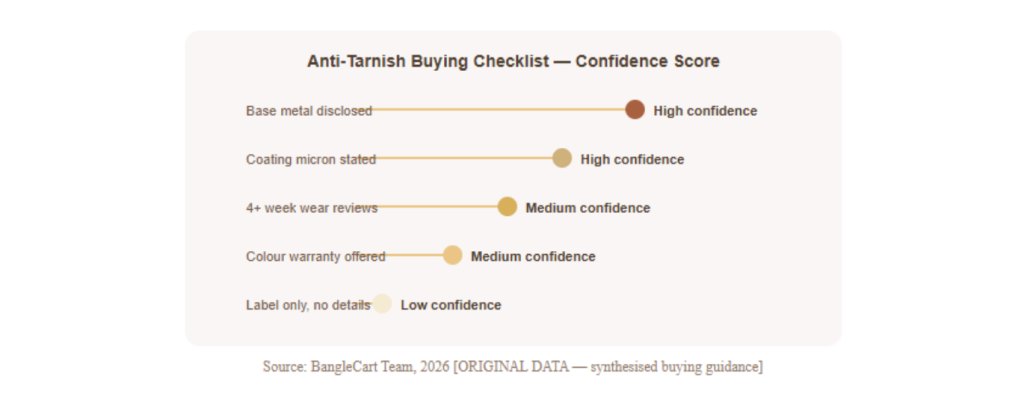
In 2026, the word “anti-tarnish” is used by every jewellery brand in India: including some who mean very little by it. Here’s how to tell the difference between genuine anti-tarnish construction and a marketing label:
- Ask for the base metal. If the answer is brass with standard plating, the piece has some anti-tarnish properties but limited durability. If the answer is 316L stainless steel with PVD, you’re getting the best available for fashion jewellery.
- Check the coating thickness. Reputable sellers mention micron thickness. A thickness of 0.5 microns or above for gold electroplating offers meaningfully better durability than flash plating.
- Look for long-term reviews. A product that looks new in unboxing photos tells you nothing. Look for reviews from buyers who have worn the piece for 4-8 weeks in Indian climate conditions.
- Check the return/warranty policy. A brand confident in anti-tarnish quality will stand behind it with at least a basic guarantee on colour retention.
Does Anti-Tarnish Jewellery Really Last Longer in India?
The evidence says yes: with one important caveat. No plated jewellery, however well-made, is tarnish-proof permanently. But the difference in lifespan between a brass-base piece with thin plating and a stainless steel base with PVD coating is substantial. A professionally made PVD-coated stainless steel piece can realistically last two or more years under Indian wear conditions (Kesheen, PVD Coating vs Electroplating for Stainless Steel Jewelry, March 2026). Thin-plated brass fashion jewellery often shows colour loss within 4–12 weeks of regular wear in humid climates.
The key maintenance habits that extend anti-tarnish jewellery life in India:
- Remove bangles and earrings before bathing or swimming, even “waterproof” claims have limits.
- Apply perfume and skincare before wearing jewellery, not after chemicals in these products accelerate coating wear.
- Store in an airtight pouch or box when not wearing, exposure to air and humidity between wears adds up.
- Wipe with a soft dry cloth after wearing, removes sweat residue before it acts on the surface.
In India’s humidity and heat, anti-tarnish jewellery based on stainless steel with PVD coating can last 2+ years of daily wear, compared to 4–12 weeks for thin-plated brass under the same conditions. Maintenance habits like pre-wear perfume application and airtight storage significantly extend any piece’s lifespan regardless of base material. [BangleCart Team, 2026]
Shop Anti-Tarnish Bangles at BangleCart
Now that you know what anti-tarnish actually means, browse our collection, every piece comes with material details listed clearly so you can buy with confidence.Shop Bangles →
Frequently Asked Questions
What does anti-tarnish mean in jewellery?
Anti-tarnish in jewellery means the piece is made or coated to resist oxidation, the chemical reaction between metal, oxygen, moisture, and sweat that causes darkening, discolouration, and green marks on skin. It doesn’t mean the jewellery is tarnish-proof forever, but it will stay shiny significantly longer than untreated fashion jewellery. The two main anti-tarnish approaches are using a stainless steel base metal (which resists oxidation naturally) and applying a protective coating like PVD or thick electroplating over the surface.
Is anti-tarnish jewellery safe to wear daily in India?
Yes, good quality anti-tarnish jewellery on a stainless steel base is safe for daily Indian wear. Stainless steel (especially 316L surgical grade) is hypoallergenic and doesn’t cause skin reactions the way brass or copper does. India’s heat and humidity mean that even anti-tarnish pieces require basic care: remove before bathing, apply perfume before (not after) wearing, and store in a pouch when not in use. With this routine, a quality anti-tarnish bangle or earring set can last 12–24 months of regular wear.
What is the difference between anti-tarnish and waterproof jewellery?
Anti-tarnish and waterproof are related but different. Anti-tarnish describes resistance to oxidation from air, sweat, and moisture over time. Waterproof (or water-resistant) specifically means the piece can withstand water exposure: showers, swimming, rain, without the coating peeling or the base metal corroding. Most quality anti-tarnish jewellery on a stainless steel base is also water-resistant, but not all waterproof jewellery has been specifically treated for tarnish. Always check which base metal is used for the most accurate understanding of a piece’s durability.
Does anti-tarnish jewellery leave green marks on skin?
If it’s genuinely anti-tarnish with a stainless steel base, it shouldn’t. The green mark comes from copper or brass in the base metal reacting with sweat, a chemical reaction that bypasses the coating once it thins. Stainless steel doesn’t produce this reaction because it contains chromium, which forms a stable protective layer on the metal’s surface. Pieces marketed as anti-tarnish but built on a brass or copper base may still leave marks once the coating wears, especially in India’s warm and humid climate.
What is the best anti-tarnish material for Indian bangles?
For Indian bangles worn frequently in humid conditions, 316L surgical-grade stainless steel with PVD (Physical Vapour Deposition) gold coating is the most durable anti-tarnish option available in fashion jewellery today. The stainless steel base resists oxidation naturally, and the PVD coating bonds at a molecular level, making it significantly harder and longer-lasting than standard electroplating over brass.
The Bottom Line: Anti-Tarnish Is Real: But Not All Claims Are Equal
Anti-tarnish jewellery isn’t a gimmick. The chemistry behind it is real, the durability difference is measurable, and for Indian shoppers dealing with heat, humidity, and daily wear, it genuinely matters. But “anti-tarnish” on a product label tells you very little unless you know what’s underneath.
The questions to ask are simple: What is the base metal? What type of coating? How thick? Any guarantee on colour? A brand that answers these directly: with specifics rather than vague claims, is a brand confident in its product. That’s the signal worth looking for, whatever your budget.
India’s artificial jewellery market is valued at approximately ₹45,000 crore and growing at over 10% annually (MarkNtel Advisors, India Artificial Jewelry Market, 2026). The best part of that growth? More brands competing on actual quality, not just price. Anti-tarnish technology is becoming the baseline expectation, which means today’s shopper has more genuinely durable options than ever before.