
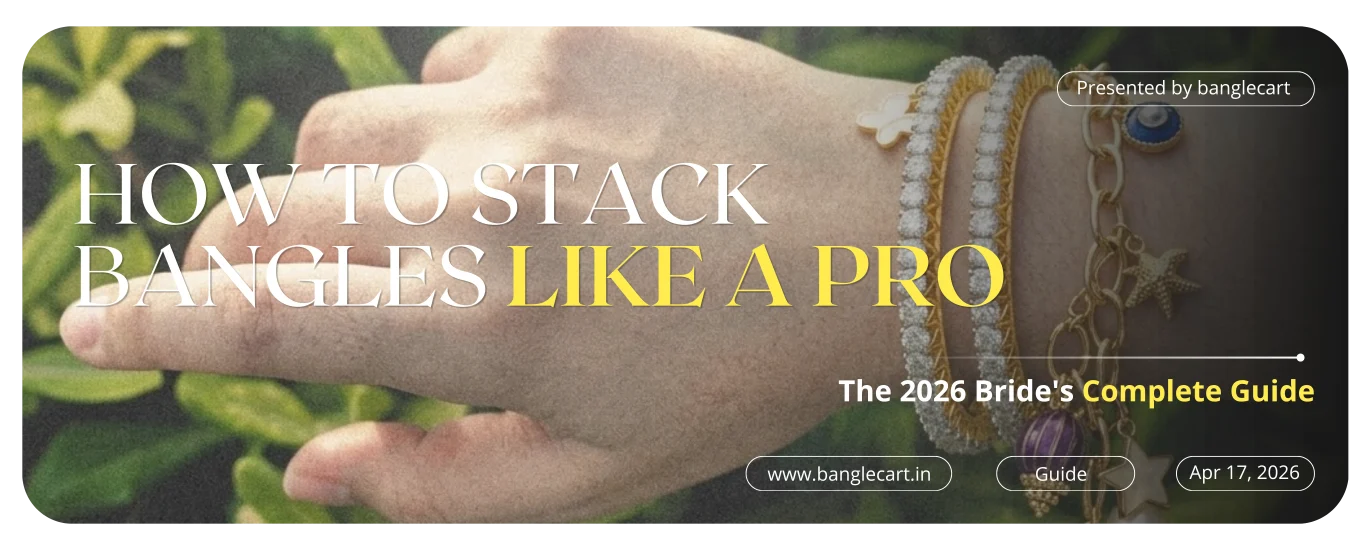
Bangle stacking means wearing multiple bangles together on one or both wrists to create a layered, personalised jewellery look. In 2026, it is the single biggest jewellery trend at Indian weddings — moving away from matching sets toward curated combinations that express individual style. This guide covers exactly how to build your stack: how many bangles to wear, which combinations work, how to mix metals and textures, and occasion-specific formulas for everything from the haldi to the reception.
Table of Contents
Why bangle stacking is the #1 jewellery trend in 2026
Bangle stacking has replaced the traditional matching jewellery set as the dominant bridal and festive jewellery style in India. The shift is being driven by three things: the rise of pre-wedding photoshoots that require multiple looks, the growing preference for jewellery that can be worn after the wedding, and social media aesthetics that reward layered, textured, editorial wrist shots.
Multiple leading bridal jewellery experts have noted this trend in their 2026 forecasts. “Layering will take centre stage, allowing brides to play with necklaces, bangles, and rings for a customised yet cohesive look,” said Vinay Gupta, Founder of Shri Paramani Jewels, in Khush Wedding’s 2026 trend report. Across bridal blogs, Pinterest, and Instagram Reels, the bangle stack — not the single heavy set — is the image most shared and saved.
For brides shopping on a budget, stacking is also a financial advantage. Instead of spending ₹8,000–₹15,000 on one gold-finish set, you can build 3–4 distinct stacked looks across your functions for ₹2,000–₹5,000 using quality artificial bangles.
How to stack bangles — the 5-step method
A beautiful bangle stack is built in layers. Follow this method for any occasion, from casual office wear to the main wedding ceremony.
Step 1: Choose your anchor bangle
Every great stack starts with one statement piece. Your anchor bangle is the widest, most eye-catching piece in your stack — the one everything else is built around. This could be a thick openable kada, a wide American Diamond bangle, a kundan cuff, or a chunky oxidised piece. Choose only one anchor per stack.
Step 2: Add your filler bangles
Filler bangles are the thin, lightweight bangles that create the layered effect on either side of your anchor. Glass bangles, plain gold-plated metal bangles, and thin CZ bangles are the most popular fillers. Use 4–10 fillers depending on how full you want the look. They should be thinner than your anchor — the contrast in width is what creates visual depth.
Step 3: Add a texture accent
A texture accent is one bangle that is visually different from the rest — a different material, colour, or finish. This is what separates a styled stack from a random collection. Good texture accents: one pearl-embellished bangle in a gold stack, one oxidised piece in a modern stack, one colour-stone bangle in a plain metal stack, or one rose-gold bangle in a yellow-gold stack.
Step 4: Balance both wrists
For weddings: stack one wrist heavily (the statement wrist) and keep the other lighter. For everyday styling: keep both wrists approximately equal with 2–4 bangles each. The statement wrist is typically the left for brides, as it holds the bouquet and is the left hand side most often photographed.
Step 5: Match the metal to your outfit colour
Use this simple rule: warm outfit colours (red, orange, mustard, pink, peach) pair with gold-toned bangles. Cool outfit colours (blue, green, purple, grey) pair with silver-toned bangles. Pastels and ivory work with both gold and rose gold. Darker outfit colours (navy, maroon, bottle green) pair best with antique gold or oxidised finishes.
Pro tip Before finalising your stack, photograph your wrist against your outfit fabric. What looks good in person sometimes disappears against a heavy embroidered lehenga. Your bangles should be visible and distinct — not lost in the embellishment.
How many bangles should you wear?
The right number of bangles depends on the occasion, your wrist size, and personal style. Here is a straightforward guide:
| Occasion | Recommended count per wrist | Style note |
|---|---|---|
| Office / daily wear | 2–4 | Keep it lightweight; openable kadas work best |
| Casual outing / festival | 4–7 | Mix glass and metal for a festive feel |
| Haldi ceremony | 6–10 | Go colourful; yellow and green glass bangles are traditional |
| Mehndi / Sangeet | 7–12 | Mix and match vibrant colours; this is your most playful stack |
| Wedding ceremony | 11–21 | Heavier, traditional; include chooda or glass bangles if desired |
| Reception night | 4–7 | Fewer, more statement-forward bangles for an elegant look |
| Engagement / roka | 6–10 | Elegant but not heavy; pastel or AD combinations work well |
Odd numbers are considered auspicious in many Indian traditions — 7, 9, 11, 13, and 21 are popular choices for ceremonial occasions. Even numbers work well for casual and contemporary styling.
Important Avoid wearing too many bangles that extend past your wrist joint — they will slip and bunch uncomfortably, especially during ceremonies where you are seated for long periods. The stack should sit comfortably between the wrist and elbow, not reaching past the wrist bone.
The best bangle combinations by type
These are the most popular and photogenic bangle stack formulas for Indian women in 2026.
The classic glass and metal stack
This is the most traditional Indian bangle combination and it remains the most loved. Pair 6–10 glass bangles in a colour that matches your outfit with 2–3 gold or silver metal bangles on the outer edges. The glass bangles create the signature sound and vibrancy; the metal bangles add structure and formality.
Best for: Haldi, mehndi, sangeet, casual festivals | Budget: ₹299–₹799
The Kashmiri bangle stack
Kashmiri bangles are metal bangles with tiny bells inside that produce a soft, musical sound. Pairing Kashmiri bangles with glass bangles creates a rich, layered wrist look that has become one of the most searched bangle combinations on Instagram and Myntra in 2026. Use 4–6 Kashmiri bangles interspersed with 4–8 glass bangles in a contrasting or matching colour.
Best for: Mehndi, sangeet, traditional weddings | Budget: ₹499–₹1,299
The AD statement stack
American Diamond (CZ stone) bangles create the most photogenic stacks because the stones catch light and sparkle in photos. Build this stack with one wide AD bangle as the anchor, 4–6 plain gold-finish thin bangles as fillers, and 1–2 AD bangles in a slightly different design (floral, geometric, or antique finish) as accents. This combination looks like a luxury jewellery set for a fraction of the price.
Best for: Wedding ceremony, engagement, reception, pre-wedding shoots | Budget: ₹699–₹1,999
The boho oxidised stack
Oxidised metal bangles in dark antique silver or black-finish give a bohemian, earthy look that pairs beautifully with indo-western outfits, cotton kurtas, and printed sarees. Build this stack with 1–2 wide oxidised bangles with carved motifs (temple, floral, or tribal patterns), 2–3 thin plain oxidised bangles, and 1 coloured stone accent. Add a thread or fabric bracelet for extra texture.
Best for: Casual occasions, fusion outfits, festive gatherings | Budget: ₹299–₹899
The pastel bridal stack
The biggest trend for 2026 brides choosing pastel lehengas. This stack uses soft-toned bangles in mint, blush, powder blue, or peach — either in glass, enamel, or resin — mixed with gold or rose-gold metal bangles. The pastel colour picks up the dominant shade of your lehenga while the metal adds elegance. Use 8–14 bangles total for a bridal-appropriate look.
Best for: Pastel lehenga brides, modern weddings, engagement | Budget: ₹599–₹1,499
| Stack type | Bangle types to combine | Occasions | Approx. cost |
|---|---|---|---|
| Glass + metal | Glass bangles + gold/silver plain bangles | Haldi, mehndi, festivals | ₹299–₹799 |
| Kashmiri + glass | Kashmiri bell bangles + coloured glass bangles | Sangeet, traditional weddings | ₹499–₹1,299 |
| AD statement | Wide AD bangle + thin plain bangles + 1–2 accent AD | Wedding, reception, engagement | ₹699–₹1,999 |
| Oxidised boho | Wide oxidised + thin oxidised + stone accent | Casual, festive, fusion wear | ₹299–₹899 |
| Pastel bridal | Pastel glass/resin bangles + rose gold metal | Pastel lehenga weddings | ₹599–₹1,499 |
Occasion-wise stacking formulas
Here are ready-made bangle stack formulas for each wedding function so you can plan your full bridal jewellery trousseau.
Haldi ceremony
The haldi ceremony calls for yellow, green, and orange — the colours of turmeric and new beginnings.
Formula: 6 yellow glass bangles + 4 green glass bangles + 2 gold-finish plain metal bangles = 12 bangles per wrist. This combination is vibrant, traditional, and perfect for outdoor haldi photographs. Since haldi stains, avoid wearing your best pieces — plain glass and simple metal bangles are ideal.
Mehndi ceremony
Mehndi is your most colourful function. Your hands will be covered in henna, so the bangles should be bold enough to stand out against the dark mehndi pattern. Formula: 1 wide Kashmiri bangle (anchor) + 6 bright glass bangles in your outfit colour + 2 gold or silver plain bangles + 1 pearl or stone accent bangle = 10–11 bangles per statement wrist.
Sangeet night
Sangeet is your dancing night — your bangles should move beautifully and make sound.
Formula: 2 Kashmiri bangles + 6 glass bangles in your sangeet outfit colour + 1 wide CZ bangle as anchor = 9 bangles per wrist. The bell sound from Kashmiri bangles adds an extra layer of joy to the dance floor.
Wedding ceremony
The main ceremony calls for your fullest, most traditional stack.
Formula: If wearing chooda — pair it with 2–4 metal bangles on the outer edges of the red and white. If not wearing chooda — 1 wide kundan or AD bangle + 8–10 glass bangles in your outfit colour + 2 plain metal bangles + 1 stone accent = 12–14 bangles per wrist.
Reception night
Reception is typically the most glamorous function and calls for your most elegant, less heavy look.
Formula: 1 wide AD bangle (anchor) + 2–3 thin gold plain bangles + 1 pearl or stone accent bangle = 4–5 bangles. Fewer bangles, more impact. This wrist looks stunning with a gown, indo-western outfit, or embellished saree.
Styling tip Plan your bangle sets as a complete wardrobe across functions, not as individual pieces. Ideally, each function should have a distinct colour story for your bangles — even if some pieces overlap. Photograph each set before the wedding to confirm how it looks against your outfit.
Mixing metals: the 2026 rules
Mixing gold and silver bangles is one of the most asked-about styling topics — and in 2026, it is not only acceptable but actively fashionable. Here is how to do it well.
The 70/30 rule
When mixing metals, let one metal dominate. A stack that is 70% gold with 30% silver looks intentional and stylish. A stack that is 50% gold and 50% silver can look unplanned. Decide which metal is your base — usually the one that matches your outfit’s embroidery or border — and use the other as an accent.
Rose gold — the universal mixer
Rose gold bangles are the easiest choice for mixed-metal stacks because rose gold sits between yellow gold and silver. It pairs naturally with both and works on every skin tone. If you are unsure about mixing metals, add rose gold bangles first — they will blend your stack effortlessly.
Match the metal to the neckline
If you are wearing a gold necklace, your bangle stack should be predominantly gold. If you are wearing a silver or oxidised necklace, your bangles should be predominantly silver or oxidised. Mixing the metal on your neck with the metal on your wrist creates a disconnected look. Your wrists and neckline should speak the same metallic language.
Oxidised with gold: the boho-bridal look
One of the most popular 2026 combinations is mixing 1–2 oxidised (dark antique) bangles into a gold stack. The dark oxidised piece adds depth and a vintage quality to an otherwise plain gold stack. This combination works especially well for brides wearing antique or heritage-style lehengas in deep jewel tones.
| Metal combination | Works with | Avoid with |
|---|---|---|
| Gold + rose gold | Warm tones, pastels, blush outfits | Cool-toned silver jewellery on neck |
| Silver + rose gold | Cool tones, blue, green, grey outfits | Heavy gold necklace sets |
| Gold + oxidised | Antique, heritage, deep jewel-tone outfits | Very modern or minimalist looks |
| All rose gold | Pastel, white, ivory, light pink outfits | Very heavy or traditional bridal sets in pure gold |
| All oxidised | Cotton, handloom, indo-western fusion wear | Heavy embroidered bridal lehengas |
Finding your bangle size
Wearing the wrong bangle size is the most common reason bangles slip off or cannot be put on without breaking. Here is the correct way to measure.
How to measure your bangle size at home
- Press your thumb and all four fingers firmly together, making your hand as narrow as possible.
- Wrap a measuring tape or a piece of string around the widest part of your hand (across the knuckle line).
- Measure the circumference in centimetres.
- Use the size chart below to find your bangle size.
| Hand circumference | Bangle size (Indian) | Diameter |
|---|---|---|
| Up to 6.3 cm | 2/2 | 5.8 cm |
| 6.4 – 6.6 cm | 2/4 | 6.0 cm |
| 6.7 – 7.0 cm | 2/6 | 6.5 cm |
| 7.1 – 7.4 cm | 2/8 | 6.8 cm |
| 7.5 – 7.8 cm | 2/10 | 7.2 cm |
| 7.9 cm and above | 2/12 | 7.6 cm |
Most adult Indian women fall between Size 2/4 and 2/8. If you are between sizes, size up — it is easier to wear a slightly large bangle than one that is too tight, especially for glass bangles which can crack under pressure.
For gifting If you are buying bangles as a wedding gift and do not know the recipient’s size, choose Size 2/6 — it fits the majority of Indian women comfortably. Alternatively, look for openable kadas or adjustable bracelets which do not require a specific size.
7 bangle stacking mistakes to avoid
- Wearing all bangles the same width. A stack of identical thin bangles reads as flat and uninteresting. Vary the width — at least one bangle should be noticeably wider than the others to create an anchor point.
- Ignoring sound. Bangles that make sound are part of their beauty. If you are building a stack, include at least some glass or bell bangles (Kashmiri bangles) for the traditional audio experience — especially for wedding functions.
- Stacking past the wrist joint. Bangles that ride up onto the forearm look unintentional and slide around awkwardly. Your stack should sit between the wrist bone and elbow, closer to the wrist.
- Matching everything too perfectly. A bangle stack where every single piece is the same colour and finish looks more like a uniform than a style choice. Include at least one contrast piece — a different metal, colour, or texture — to make the stack look curated.
- Buying the wrong size for glass bangles. Glass bangles in the wrong size either will not go on or will be uncomfortably tight. Always measure before ordering online. Glass bangles cannot be resized and are non-returnable once used.
- Wearing heavy bangles on both wrists equally. At a wedding, a heavily stacked wrist on both sides looks balanced in theory but exhausting in practice. You will be moving your arms for 4–6 hours. Stack one wrist heavily and keep the other lighter.
- Leaving care to the last minute. Bangles need to be stored properly — glass and stone-set bangles must not knock against each other, which causes chips and breaks. Store your wedding bangle sets in separate pouches or cloth-wrapped boxes before the function day.
Shop bangle stacks built for the 2026 wedding season — glass, AD, Kashmiri, and bridal sets from ₹299Browse All Bangles at BangleCart →
Frequently asked questions
How many bangles should a bride wear?
Indian brides typically wear 11 to 21 bangles on each wrist for the main wedding ceremony. For sangeet or mehndi, 7–11 bangles is comfortable. For the reception night, 4–7 statement bangles is considered elegant. The traditional belief is that more bangles bring more blessings — but comfort matters too. Choose a count that lets you move freely throughout the function.
Can you mix gold and silver bangles?
Yes — mixing metals is one of the most popular jewellery trends in 2026. The key is using the 70/30 rule: let one metal dominate and use the other as an accent. Rose gold is the easiest way to bridge gold and silver tones naturally, as it pairs well with both. Match your dominant bangle metal to the metal in your necklace for a cohesive look.
How do you put on glass bangles without breaking them?
Press your thumb and fingers firmly together to make your hand as narrow as possible. Apply a small amount of moisturiser or a little soap to make the skin slippery. Hold the bangle vertically and gently rotate it onto the hand while the fingers remain pressed together. Never force a bangle past resistance — if it does not slide on easily, it is too small. Measure your hand circumference at the knuckle before buying glass bangles.
Which bangles go on which wrist?
There is no strict rule. Traditionally, the left wrist is for chooda or glass bangles, and the right wrist is for metal or kundan bangles. In practice, stack your heavier, more statement-forward set on the wrist that will be most photographed at your wedding. For most brides, the left wrist is photographed more frequently during the pheras and ring exchange.
Can artificial bangles be worn for a wedding?
Absolutely. High-quality artificial bangles in American Diamond, kundan, gold-plated, and oxidised finishes are the most popular choice for modern Indian brides in 2026. They are lightweight, look identical to fine jewellery in photographs, and allow brides to create multiple distinct looks across functions without the cost of real gold. BangleCart’s bridal bangle sets range from ₹299 to ₹1,999 and are designed specifically for Indian wedding functions.
How to stack bangles for daily wear?
For daily wear, a stack of 2–4 lightweight bangles is most practical. Start with one openable kada or medium metal bangle as your base, then add 1–2 thin plain bangles in the same metal tone. Avoid glass bangles for daily office wear — they chip easily and can catch on clothing. Choose anti-tarnish, skin-safe materials and store them flat when not in use.
What size bangle should I buy?
Measure your hand circumference by pressing your thumb and fingers together tightly and wrapping a measuring tape around the widest point across the knuckles. Most Indian women fall between Size 2/4 (6.4–6.6 cm hand circumference) and 2/8 (7.1–7.4 cm). When in doubt, size up — especially for glass bangles, where going too small can cause the bangle to break during wear.
How do I care for my bangle stack after the wedding?
Store each type of bangle separately: glass bangles in a soft cloth pouch, metal and AD bangles in individual compartments or a jewellery box with dividers. Avoid contact with water, perfume, and sweat for extended periods — these can cause gold plating to fade and glass bangles to become dull. Wipe metal bangles with a soft dry cloth after each use. Anti-tarnish zip-lock bags are ideal for long-term storage of gold-plated pieces.
Related reads on BangleCart:
Shop All Bangles | Jewellery Styling Blog | Jewellery Under ₹499 | Jewellery Under ₹999
BangleCart Team
The BangleCart Team specialises in Indian artificial jewellery, bangle styling, and bridal accessory guidance. We have been helping Indian women find the right bangles for every occasion since our launch — from everyday wear to full wedding trousseau planning. All our content is reviewed for accuracy and updated regularly to reflect the latest trends and product availability.