
Artificial jewellery — also called imitation jewellery or fashion jewellery — has become one of the most practical and style-forward choices for Indian women in 2026. Whether you are building an everyday jewellery wardrobe, shopping for festivals, or looking for the perfect gift under ₹999, this guide covers everything you need to know: what it is, how to buy it, how to care for it, and how to get the most from it.
Use the section links below to jump to what you need, or read through for the full picture.
Table of Contents
1. What is artificial jewellery?
Definition: Artificial jewellery — also called imitation jewellery, fashion jewellery, or costume jewellery — is jewellery made from non-precious base metals such as brass, copper, or zinc alloy, plated with gold or silver tones and set with synthetic stones. It replicates the look of fine jewellery at a fraction of the cost, typically ranging from ₹199 to ₹2,000 per piece in India.
The term covers a wide spectrum — from simple ₹299 charm bracelets to elaborate ₹1,999 bridal-style necklace sets with American diamond detailing. What unites all artificial jewellery is its base: no precious metals, no certified gemstones, but increasingly strong craftsmanship and finish quality.
In India, artificial jewellery is also called:
- Imitation jewellery — the most common trade term
- Fashion jewellery — used for western or contemporary styles
- Costume jewellery — used in bridal and film contexts
- Artificial gold jewellery — specifically for gold-plated pieces
- AD jewellery — American Diamond, refers to cubic zirconia stone settings
2. Types of artificial jewellery in India
Indian artificial jewellery spans a wide range of styles, finishes, and materials. Here are the main types you will encounter when shopping:
| Type | What it is | Best for | Price range |
|---|---|---|---|
| Gold-plated | Base metal electroplated with gold tone | Daily wear, ethnic outfits, festivals | ₹299 – ₹1,999 |
| American Diamond (AD) | Cubic zirconia stones set in gold or silver base | Weddings, parties, bridal-look pieces | ₹499 – ₹1,999 |
| Oxidised silver | Blackened silver-tone finish for antique look | Boho, tribal, ethnic, indo-western | ₹299 – ₹1,200 |
| Kundan | Stones set in gold foil — traditional Rajasthani style | Bridal, heavy ethnic, weddings | ₹799 – ₹3,000+ |
| Meenakari | Enamel colour work on metal base | Festive, traditional, statement pieces | ₹499 – ₹2,000 |
| Pearl / beaded | Faux pearl or bead strands, often layered | Office, sarees, classic looks | ₹299 – ₹999 |
| Anti-tarnish | Any of the above with protective coating for longer life | Daily wear, humid climates, active lifestyles | ₹499 – ₹1,999 |
3. Price guide — what to expect at every budget
Artificial jewellery in India spans a wide price range. Here is what each budget tier typically delivers in 2026:
| Budget | What you get | Best used for |
|---|---|---|
| Under ₹499 | Single pieces — charm bracelets, studs, thin bangles, dainty necklaces. Light plating, simple designs. Good for everyday basics. | Daily use, casual gifting, trend pieces you’ll rotate out |
| ₹499 – ₹999 | Sets and combos, thicker plating, crystal stone detailing, anti-tarnish options, multi-layer designs. Noticeably better finish quality. | Gifting, festivals, office wear, building a core wardrobe |
| ₹999 – ₹1,999 | Premium sets, AD stone pieces, bridal-inspired designs, complete necklace + earring combos, heavy-look statement pieces. | Special occasions, weddings (as guest), milestone gifting |
At BangleCart, our collection spans all three tiers — from ₹299 to up to ₹1,999, with most bestsellers in the ₹499–₹999 range. Browse by budget: under ₹499 · under ₹999 · under ₹1,999.
4. How to buy artificial jewellery online in India — 6 things to check
Buying artificial jewellery online comes with one real risk: you cannot feel the weight or finish before it arrives. These six checks protect you from disappointment:
1. Check for nickel-free and skin-safe claims
Nickel is the most common cause of jewellery-related skin irritation. Any reputable brand selling artificial jewellery should explicitly state nickel-free alloys. If the product listing does not mention skin safety, treat it as a risk.
2. Read the plating description, not just the colour
“Gold-plated” means electroplated metal — proper plating applied in layers. “Gold-coloured” or “gold-tone” without the word “plated” can mean painted or powder-coated, which fades much faster. Look for electroplated or micron gold in the product details.
3. Check the return and exchange policy before ordering
Jewellery sizing (especially bangles) can be tricky online. Before ordering, confirm the brand has a clear return or exchange policy. At BangleCart, our return policy covers all purchases.
4. Know your size before ordering bangles
Bangles must slide over your hand and cannot be adjusted. Measure your hand before ordering — our complete Indian bangle size guide walks you through the process in under two minutes.
5. Look for real product photos, not just renders
Computer-rendered product images can misrepresent finish quality. Prefer brands that show actual product photography — ideally on a model — so you can judge the real scale, weight, and finish before buying.
6. Anti-tarnish = longer life for daily wear
If you plan to wear a piece regularly, prioritise anti-tarnish finishes. They significantly slow colour change and oxidation. Not all artificial jewellery carries this coating — check the product page or filter for it specifically.
5. Occasion guide — what artificial jewellery to wear when
The right jewellery changes completely depending on the occasion. Here is a quick reference for Indian women across common contexts:
| Occasion | Recommended style | What to avoid |
|---|---|---|
| Daily office wear | Stud earrings, thin bangles, simple chain bracelet, dainty pendant | Heavy jhumkas, stacked bangles, statement necklaces |
| College / casual | Charm bracelets, hoops, layered necklaces, mix-and-match sets | Overly formal or bridal-style pieces |
| Navratri / Diwali | Crystal bangle sets, jhumkas, layered necklaces, colourful meenakari | Minimalist or plain pieces — go bold for festivals |
| Wedding (as guest) | AD stone sets, Kundan-look pieces, gold-plated bangle sets | Pieces that look visibly costume or flimsy |
| Karva Chauth / Teej | Red or gold bangles, traditional designs, layered ethnic sets | Western or minimal jewellery — tradition calls for abundance |
| Date / evening out | Tennis bracelet, hoop earrings, pearl bracelet, dainty pendant | Heavy traditional pieces with western outfits |
| Gifting any occasion | Charm bracelet, evil eye piece, gifting combo set, pearl bracelet | Bangles as a gift — sizing is hard to get right without measuring |
For detailed gifting recommendations with prices, see our complete jewellery gifting guide under ₹999.
6. How to care for artificial jewellery — 5 rules that double its life
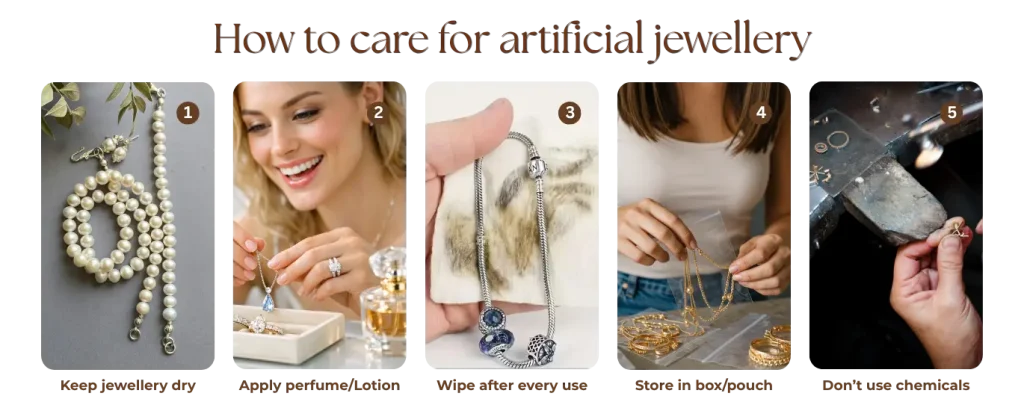
The biggest reason artificial jewellery fades quickly is not poor quality — it is poor care. These five rules apply to all plated and imitation jewellery regardless of price:
- Keep it completely dry. Water is the fastest enemy of plated jewellery — it accelerates oxidation and strips the plating layer. Remove all artificial jewellery before bathing, swimming, washing dishes, or exercising. Even brief contact speeds up tarnishing.
- Apply perfume and lotions before putting on jewellery. Chemicals in perfume, hairspray, and body lotion react with metal plating and dull the finish. Spray, apply, let it dry fully — then wear your jewellery.
- Wipe after every wear. A quick wipe with a soft dry cloth after each use removes skin oils, sweat, and dust that gradually break down the plating. Takes ten seconds and meaningfully extends the life of a piece.
- Store in a dry, airtight pouch or box. Humidity causes tarnishing even when jewellery is not being worn. Keep pieces in the pouch they came in, or in individual compartments in a jewellery box. Avoid bathroom storage — the moisture is damaging.
- Never use chemical cleaners. Toothpaste, vinegar, baking soda, and jewellery cleaning liquids designed for silver or gold will strip artificial plating. For cleaning, use only a soft dry cloth or a barely damp cloth with plain water, dried immediately.
For a deeper cleaning guide with 7 safe methods for different types of artificial jewellery, see: How to clean artificial jewellery at home.
7. Artificial jewellery vs gold — the short version
Artificial jewellery wins on price, variety, daily wearability, and gifting flexibility. Gold jewellery wins on resale value, lifelong durability, and cultural significance for milestone occasions. For most Indian women, the smartest approach is both: gold for milestones, artificial for everything else.
| Factor | Artificial | Gold |
|---|---|---|
| Price | 🏆 | — |
| Design variety | 🏆 | — |
| Daily wearability | 🏆 | — |
| Resale value | — | 🏆 |
| Durability | — | 🏆 |
| Cultural significance | — | 🏆 |
For the complete 10-factor breakdown with pros, cons, and a buying decision guide, read: Artificial Jewellery vs Gold Jewellery India — Which is Better in 2026?
8. How to spot a quality artificial jewellery brand in India
The Indian artificial jewellery market ranges from reliable, skin-safe brands to low-quality pieces that fade within days. Five signals that separate good brands from bad ones:
- Explicit skin-safety claims. Quality brands state nickel-free, lead-free, and hypoallergenic clearly — not buried in fine print. If a brand does not mention this at all, it is worth questioning what is in the base metal.
- Plating described clearly. Good brands specify the type of plating — gold electroplated, micron gold, 18kt gold tone — rather than vague terms like “gold-coloured” or “shiny gold”.
- Real product photography. Renders look perfect. Real photos show actual finish, weight, and scale. Brands confident in their product quality show how pieces actually look on a person.
- Transparent return policy. A brand that stands behind its quality offers a clear return or exchange window. Brands that make returns difficult often know their product will not meet expectations.
- Anti-tarnish options available. Brands that invest in anti-tarnish coating are thinking about longevity, not just initial appearance — a signal of quality focus.
At BangleCart, all pieces use nickel-free alloys, and several carry anti-tarnish finishes. Our return policy is published clearly at banglecart.in/return-policy.
Frequently asked questions
What is artificial jewellery called in India?
Artificial jewellery in India is commonly called imitation jewellery, fashion jewellery, or costume jewellery. Specific types are known by their style names — Kundan jewellery, Meenakari jewellery, American Diamond (AD) jewellery, and oxidised silver jewellery. In trade contexts, the terms artificial and imitation are used interchangeably.
Is artificial jewellery safe for sensitive skin?
It can be — provided the jewellery is made from nickel-free and lead-free alloys. Nickel is the most common cause of metal allergies and skin irritation. Always check product descriptions for skin-safe or hypoallergenic claims before buying. Avoid pieces that do not specify their base metal composition, as these may contain nickel or other irritants.
How long does artificial jewellery last in India?
With proper care, good-quality artificial jewellery lasts 1–3 years before noticeable fading. Anti-tarnish pieces last longer. The biggest factors affecting lifespan are contact with water, perfume, and sweat — and how the pieces are stored when not in use. Pieces kept dry, stored properly, and wiped after wearing regularly last significantly longer.
Where is artificial jewellery made in India?
The major artificial jewellery manufacturing hubs in India are Jaipur (Rajasthan) — known for Kundan and Meenakari work, Mumbai — especially Zaveri Bazaar for wholesale imitation jewellery, Kolkata — known for gold-plated fashion jewellery, and Surat (Gujarat) — known for AD stone jewellery and beaded designs. Most online brands source from or manufacture in these cities.
What is anti-tarnish jewellery?
Anti-tarnish jewellery has a protective coating applied during finishing that significantly slows oxidation and colour change — the main causes of artificial jewellery fading. The coating is invisible and does not change the appearance of the piece. Anti-tarnish jewellery requires the same basic care as regular artificial jewellery, but holds its finish noticeably longer with regular wear.
How do I find my bangle size for online shopping?
Press your thumb and little finger together, measure the circumference around the widest part of your hand, divide by 3.14 to get your diameter, then match to the Indian bangle size chart — where size 2/6 (6.0 cm diameter) is the most common adult size. Full step-by-step guide: How to choose bangle size at home.
Shop BangleCart’s artificial jewellery collection
BangleCart offers skin-safe, well-finished artificial jewellery for Indian women — bangles, bracelets, earrings, necklaces, rings, and gifting combos, from ₹299 to ₹1,999. Every piece is lightweight, designed for everyday wear, and shipped across India.
- Jewellery under ₹499 — everyday basics and budget picks
- Jewellery under ₹999 — sets, gifting, and festival picks
- Shop bangles
- Shop bracelets
- Shop earrings
- Shop necklaces
- Shop gifting combos