
Artificial jewellery is safe for sensitive skin — but only when made from the right metals. Most skin reactions are caused by nickel, which is used in cheap alloys. Here is what matters:
- Safe metals: Surgical-grade stainless steel (316L), titanium, rhodium-plated finishes.
- Avoid: Nickel alloys, uncoated brass, anything labelled “metal alloy” with no detail.
- Reaction signs: Redness, itching, or rash within 12–48 hours of wearing.
- Green skin = copper oxidation, not allergy — different cause, same solution: switch metals.
- 5 daily habits that protect sensitive skin from any jewellery, covered below.
Fact 1 — Artificial Jewellery Is Safe for Sensitive Skin (With the Right Metals)
Is artificial jewellery safe for sensitive skin? Yes — and the answer depends entirely on the metal, not the price of the piece. Millions of women with sensitive skin wear artificial jewellery every day without any reaction. The ones who experience problems are almost always reacting to a specific material in the alloy, most often nickel.
Sensitive skin does not mean you cannot wear artificial jewellery. It means you need to know which metals are safe before you buy. A ₹299 piece in surgical-grade stainless steel will cause zero reaction on reactive skin. A ₹1,500 piece in a nickel alloy will cause a reaction within hours. Price is not the protection — metal composition is.
💍
Artificial jewellery safe for sensitive skin — BangleCart
Artificial jewellery safe for sensitive skin: the right metal makes all the difference. Image: BangleCart collection.
Fact 2 — Nickel Is the #1 Cause of Jewellery Skin Reactions in India
Nickel allergy is the most common contact allergy worldwide, affecting an estimated 8–15% of people. In India, where fashion jewellery made with nickel-heavy alloys is widespread in street markets and budget brands, the exposure rate is high. The reaction is called allergic contact dermatitis — an immune response triggered when nickel ions dissolve from the metal and penetrate the skin.
What makes nickel allergy worse over time: every exposure sensitises the immune system further. A reaction that starts as mild redness with a cheap bangle can, over months of repeated exposure, become a severe and instant reaction. Switching to nickel-free metals early is the only way to prevent this progression.
According to the American Academy of Dermatology, nickel allergy is permanent once developed — there is no cure, only avoidance. This is why choosing the right metal for artificial jewellery for sensitive skin is not a small decision.
⚠️ Watch Out for “German Silver”“German silver” or “white metal” sounds premium but contains no silver. It is a nickel-copper-zinc alloy — one of the most reactive materials for sensitive skin. Avoid any piece listed as German silver if you have skin sensitivities.
Fact 3 — Green Skin Is Not a Nickel Allergy (But Still a Warning Sign)
Green staining on your wrist or neck from jewellery is not an allergic reaction. It is a chemical reaction between copper-based alloys (brass or bronze) and your sweat and skin acids. The green compound produced is copper carbonate — the same chemistry that turns the Statue of Liberty green.
Green staining from artificial jewellery for sensitive skin is harmless in most cases, but it is a clear sign the base metal is reactive to your skin chemistry. If you are already prone to skin reactions, a green-staining piece should be treated as a warning and swapped for one with a safer base metal.
How to Identify a Jewellery Skin Reaction on Sensitive Skin
Knowing the signs helps you act quickly — and stop wearing the piece before the irritation worsens. Reactions from artificial jewellery on sensitive skin typically appear 12–48 hours after wearing and can linger for several days after removal.
🔴 Signs of a Jewellery Skin Reaction
- Redness or pink discolouration exactly where the jewellery rested on skin
- Itching — often the first symptom, appearing within a few hours of wearing
- Small raised bumps or blisters at the contact point
- Dry, scaly patches appearing 1–2 days after contact
- Warmth or mild swelling at the contact area in more severe cases
- Green or grey stain on skin — copper oxidation, not allergy, but a signal to switch metals
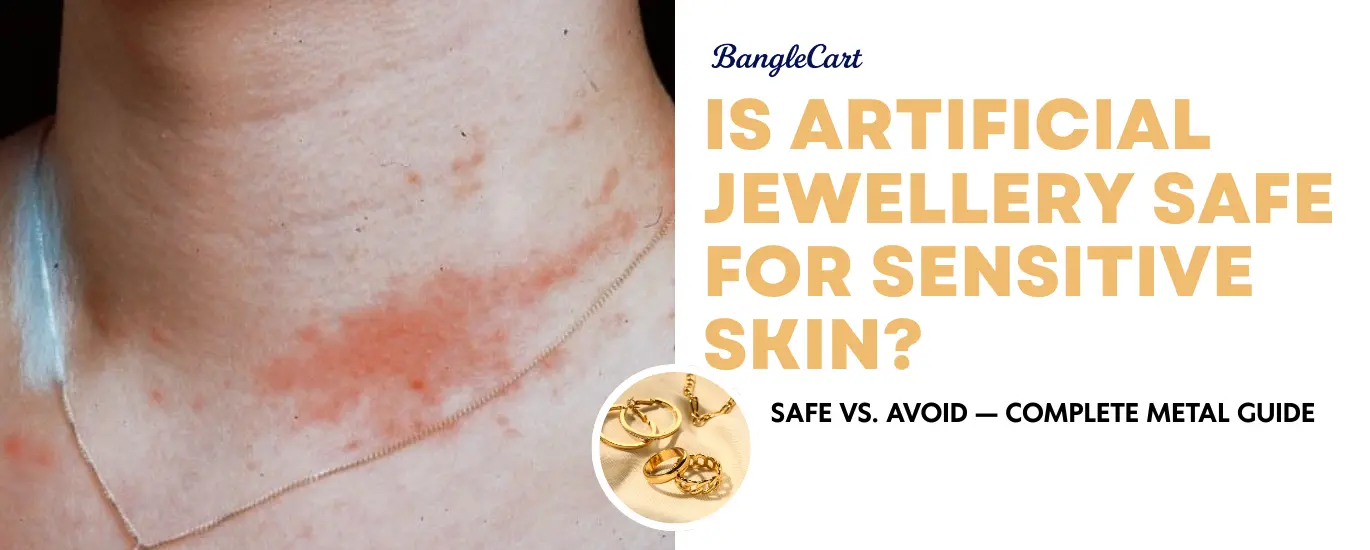
Jewellery skin reaction symptoms — what to look for
Jewellery skin reactions on sensitive skin: redness and itching at the contact area are the most common early signs.
When to See a Dermatologist: If your reaction is spreading beyond the contact area, recurring despite switching jewellery, or accompanied by significant swelling or weeping blisters, see a dermatologist. A simple patch test confirms exactly which metals trigger your sensitivity — a 15-minute test that can permanently change how you shop for jewellery.
Safe vs. Avoid — Complete Metal Guide for Sensitive Skin
This is the most practical reference in this guide. When reading a product description for artificial jewellery for sensitive skin, look for these exact terms — and walk away from these red flags.
Safe for Sensitive Skin
- Surgical-Grade Stainless Steel (316L)The gold standard for sensitive skin. Nickel-free, rust-resistant, hypoallergenic. Safe for daily wear, including through sweat and humidity.
- Titanium: Completely biocompatible — the same material used in surgical implants. Zero allergic reactions reported. Lightweight and extremely strong.
- Rhodium-Plated Finishes: Rhodium is a platinum-group metal — hypoallergenic and inert. A good rhodium coating creates a protective barrier between skin and base metal.
- Anti-Tarnish Coated Pieces. The coating acts as a skin barrier. Safe while intact — replace pieces once the coating visibly wears off to avoid base metal contact.
❌ Avoid for Sensitive Skin
- Nickel AlloysMost common cause of contact dermatitis from artificial jewellery. Found widely in budget pieces. Avoid entirely if you have reactive skin.
- Uncoated Brass or Bronze: Copper-based alloys that oxidise against sweat. Causes green staining and irritation on already sensitive skin.
- “Metal Alloy” (Unspecified)When the listing only says “metal alloy” with no detail, assume it may contain nickel. Avoid if you are reactive.
- German Silver / White MetalContains no silver. It is a nickel-copper-zinc alloy — one of the worst choices for sensitive skin, despite the name.
Safe metals vs avoid — jewellery for sensitive skin India
Safe metals for sensitive skin: Surgical steel, titanium, and rhodium are the three safest options for everyday artificial jewellery wear.
Fact 4 — Coatings Protect Sensitive Skin, But Base Metal Matters More
A high-quality anti-tarnish coating or lacquer on artificial jewellery for sensitive skin creates a physical barrier between the base metal and your skin. This can delay or prevent reactions entirely — as long as the coating is intact.
The problem: coatings wear off. Daily wear, contact with water, sweat, and lotions all degrade the coating over weeks and months. Once the coating breaks down, the base metal is directly touching your skin. If that base metal contains nickel or reactive brass, the reaction that was being prevented will begin.
This is why checking the base metal composition is more important than checking for coatings when buying artificial jewellery for sensitive skin. A good coating on a safe base metal extends the life of that safety. A good coating on a nickel base is a delayed reaction waiting to happen.
Fact 5 — India’s Climate Makes Sensitive Skin React Faster to Unsafe Metals
In Bangalore, Mumbai, Chennai, and across coastal India, high ambient humidity for much of the year means skin is consistently damp and more permeable. Sweat accelerates the dissolution of metal ions — including nickel — from alloy surfaces into the skin.
A piece that might cause a mild reaction in a dry European climate can cause a more significant reaction on sensitive skin in Indian conditions within the same amount of wear time. If you live in a high-humidity region of India and have sensitive skin, prioritise surgical-grade stainless steel over gold-plated pieces, especially for earrings and wrist jewellery worn through the day.
“A ₹299 surgical steel bracelet is safer for sensitive skin than a ₹1,500 nickel-alloy piece. Skin safety is a metals problem, not a price problem.”
5 Proven Habits That Protect Sensitive Skin From Jewellery Reactions
Even with the right metals, daily habits make a significant difference in how sensitive skin responds to artificial jewellery. These five habits reduce reaction risk for any skin type.
1. Remove jewellery before washing hands, showering, or exercising
Water, soap, and sweat accelerate coating breakdown and increase the speed at which metal ions transfer to skin. Even safe metals cause fewer reactions when given regular breaks from skin contact.
2. Apply moisturiser before putting jewellery on — not after
A thin layer of moisturiser on your wrist or earlobe creates a light barrier between skin and metal. Let it dry completely first so it does not degrade the piece’s coating.
3. Wipe pieces dry after wearing, especially on humid or sweaty days
Sweat trapped between skin and metal dramatically speeds up oxidation and coating breakdown. A 30-second dry cloth wipe after removing each piece removes this residue and extends coating life significantly.
4. Rotate your jewellery — do not wear the same piece every single day
Continuous, uninterrupted wear prevents skin from recovering between uses. Rotating 2–3 pieces means each is worn 3–4 days a week rather than 7, reducing cumulative exposure to even the safest metals.
5. Do a 2–3 hour patch test with any new piece before daily wearing
Wear the new piece for 2–3 hours. Remove it and check the contact area 24 hours later. No redness or itching means proceed with normal wear. This applies even to pieces labelled hypoallergenic, since individual skin chemistry varies.
What to Look for When Buying Artificial Jewellery for Sensitive Skin
The product listing tells you almost everything you need — if you know what to look for. When shopping for artificial jewellery for sensitive skin, use this as your buying checklist.
✅ Green Flags — Buy with Confidence“Nickel-free” · “Hypoallergenic” · “Surgical-grade stainless steel” or “316L” · “Anti-tarnish coating” · “Rhodium-plated” · “Titanium” · Specific metal composition listed (e.g., “zinc alloy base with gold plating”)
⚠️ Red Flags — Proceed With Caution or Avoid“Metal alloy” with no further specification · “White metal” · “German silver” · No metal information in the listing at all · Very low prices with zero material information
Best BangleCart Pieces for Sensitive Skin
These BangleCart pieces feature anti-tarnish coatings and polished finishes that make them well-suited for sensitive skin. Always perform a patch test with any new piece, and follow the 5 habits above to get the most comfortable wear.
Best Bracelets for Sensitive Skin
Classic Crystal Tennis Bracelet₹499Gold-Plated Screw Bracelet₹499Twisted Chain Bangles Set of 2₹499
Smooth, polished finishes mean minimal surface-area contact against skin — which reduces both friction and reaction risk. The flat, even surface also makes the daily wipe-down far more effective than textured or stone-set pieces.
Best Earrings for Sensitive Skin
Stud earrings are better than dangling earrings for sensitive earlobes — they are lighter (less pull), and the contact area is minimal. Studs also let the earlobe breathe better than hoops or drops that wrap around the ear.
Best Necklaces for Sensitive Skin
Gold Floral Pendant Necklace₹599Classic Pearl Bead Necklace₹699
For necklaces, the chain rests on the back of the neck — a lower-friction area than wrists or earlobes. The pearl bead necklace has an added advantage: most of what touches your skin is the pearl beads rather than the metal chain, minimising metal-to-skin contact throughout the day.
BangleCart pieces recommended for sensitive skin — anti-tarnish collection
BangleCart pieces with anti-tarnish coatings and polished finishes — the best choices for sensitive skin jewellery wear.
Shop BangleCart’s Anti-Tarnish Collection
Designed for daily wear in Indian weather. Anti-tarnish coatings, polished finishes, and gentle on sensitive skin.Browse the Full Collection →
FAQ — Artificial Jewellery for Sensitive Skin, Answered
Is artificial jewellery safe for sensitive skin?
Yes — artificial jewellery is safe for sensitive skin when made from nickel-free metals like surgical-grade stainless steel (316L), titanium, or rhodium-plated finishes. Most reactions are caused by nickel alloys or uncoated brass, not artificial jewellery as a category. The metal, not the price or style, determines whether a piece is safe for your skin.
What causes artificial jewellery to irritate and react with sensitive skin?
The most common cause is nickel, used in the base alloy of many low-cost pieces. When nickel-containing metal is in prolonged contact with skin, especially with sweat, nickel ions dissolve slightly and trigger an immune response called allergic contact dermatitis. Copper and brass bases cause green staining through a separate chemical reaction — not an allergy, but still a sign the metal is incompatible with your skin.
Which metals in artificial jewellery are safe for sensitive skin?
Surgical-grade stainless steel (316L), titanium, and rhodium-plated finishes are the safest metals for sensitive skin. When reading product descriptions, look for “nickel-free,” “hypoallergenic,” or a specific metal composition. Walk away from anything listed only as “metal alloy,” “white metal,” or “German silver” — these are red flags for nickel content.
How do I know if I am reacting to my jewellery?
Signs of a jewellery skin reaction include redness, itching, small bumps or blisters at the point of contact, appearing within 12–48 hours of wearing the piece. The reaction appears exactly where the metal touched skin — wrist, earlobe, or neck. Green skin staining is a separate copper reaction, not the same as a nickel allergy.
Can I wear artificial jewellery if I have a nickel allergy?
Yes — choose strictly nickel-free metals. Surgical-grade stainless steel and titanium contain no nickel and are safe for people with confirmed nickel allergies. Always verify the metal composition in the product description before purchasing, and do a short patch test with any new piece before wearing it all day.
Does anti-tarnish coating prevent skin reactions from artificial jewellery?
Yes, temporarily. An anti-tarnish coating creates a barrier between the base metal and your skin, which can prevent or delay reactions while the coating is intact. But coatings wear off with daily use — once the coating breaks down, the base metal contacts your skin directly. This is why the base metal composition matters more than the coating for long-term safe wear.
Medical Disclaimer: This guide provides general information about metals and skin reactions based on widely documented dermatological knowledge. It is not medical advice. If you are experiencing significant skin reactions, persistent rashes, or worsening symptoms, please consult a qualified dermatologist for a proper diagnosis and personalised treatment.